Lesson 9: Scales & Intervals
During the Middle Ages, eight Gregorian
Modes (or church modes) were used when singing Gregorian chants. These modes became the basis for all modern
scales are each composed of two tetrachords. Today, only seven modes are used -- their tetrachords can be intermixed,
creating yet more scales in each key. (Modern modes can be
transposed.) As discussed
at Frankie George's Music Tutor website, the church modes have starting and ending notes, reciting tones and vocal ranges.
Today, the most common vocal ranges are Soprano,
Alto, Tenor and Bass. One can include these vocal ranges in with the ranges of instruments -- and see where one should
begin any mode or derived scale. The major scale was derived from the Ionian mode and the minor scale was derived from
the Aeolian mode. Jazz makes heavy use of modes as well as the scales derived from them.
Today, seven modes are used in music: Ionian, Dorian, Phrygian, Lydian, Mixolydian, Aeolian and Locrian. These
modes each begin on a successive tone of the Ionian mode (or major scale)." Each note of the mode is assigned a
numeric value corresponding to its melodic/harmonic function. The assigned degree and corresponding
formula of each note relate to the diatonic function
associated with that note.
I = Tonic
II = Supertonic
III = Mediant
IV = Subdominant
V = Dominant
VI = Submediant
VII = Leading
The most important functions in any mode or scale are I, IV and V. The tonal center of a piece of music is usually based on the I degree and the bass line will jump to the IV or V degree, establishing a movement away from or to the tonic "home base" that has been established. Music passes through different keys, even though the key signature does not change (the key signature of the tonic root is used). Music uses the modes. scales AND chords associated with the diatonic function that is currently in use at a particular measure.
Using tetrachords, a wide variety of scales can be produced, and even new chords can result based on use of the intervals between each note. Many musicians make use of the chords and intervals that are applicable to each mode or scale. Notes that are part of a mode/scale can be harmonized in many ways. Usually, every other note is used to avoid dissonance. On the other hand, sometimes notes that produce dissonance, as opposed to consonance, ARE used. Compositions move away from and towards the tonic key (the further away that a key signature's notes are from the tonic scale, the more dissonance there is).
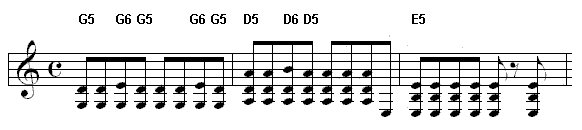
In I Want To Hold Your Hand, use of G5 and G6 (harmonic intervals) creates much of what is heard in the composition. This type of syncopation was used by Chuck Berry and makes use of repetitive chord patterns. Lennon liked to play 2 or 3 note voicings with his guitar. He uses power chords in the introduction and in the verses. The lead parts played by Harrison in the chorus (0:52) and just prior to the chorus also contribute much to this song. During the chorus, the lead guitar part is the loudest until 1:03.
I = Tonic
II = Supertonic
III = Mediant
IV = Subdominant
V = Dominant
VI = Submediant
VII = Leading
The most important functions in any mode or scale are I, IV and V. The tonal center of a piece of music is usually based on the I degree and the bass line will jump to the IV or V degree, establishing a movement away from or to the tonic "home base" that has been established. Music passes through different keys, even though the key signature does not change (the key signature of the tonic root is used). Music uses the modes. scales AND chords associated with the diatonic function that is currently in use at a particular measure.
Using tetrachords, a wide variety of scales can be produced, and even new chords can result based on use of the intervals between each note. Many musicians make use of the chords and intervals that are applicable to each mode or scale. Notes that are part of a mode/scale can be harmonized in many ways. Usually, every other note is used to avoid dissonance. On the other hand, sometimes notes that produce dissonance, as opposed to consonance, ARE used. Compositions move away from and towards the tonic key (the further away that a key signature's notes are from the tonic scale, the more dissonance there is).
In I Want To Hold Your Hand, use of G5 and G6 (harmonic intervals) creates much of what is heard in the composition. This type of syncopation was used by Chuck Berry and makes use of repetitive chord patterns. Lennon liked to play 2 or 3 note voicings with his guitar. He uses power chords in the introduction and in the verses. The lead parts played by Harrison in the chorus (0:52) and just prior to the chorus also contribute much to this song. During the chorus, the lead guitar part is the loudest until 1:03.
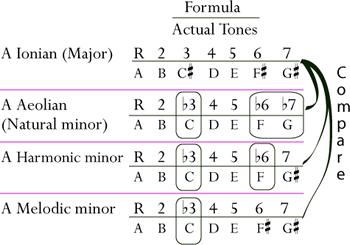
All scales and chords have a Root (R) note that is
the first note of the Tonic chord -- and the first note of the associated scale. As seen below, the
A Root has 1 major scale and 3 minor scales associated with it. These are the scales derived
from the Ionian and Aeolian modes -- with exception of the last two scales. The harmonic and melodic minor scales resulted due
to composers not being satisfied with the two former scales -- and these scales were modified to satisfy what was heard. The
intervals between the notes at the end of the
scales was of significance. Referring to the diagram, note the difference between successive pitches. The progression of
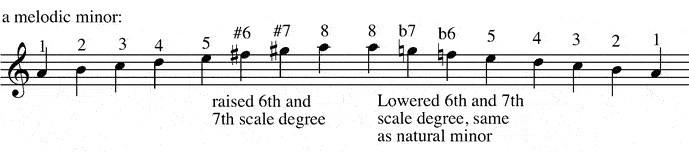
each note is not the same. In fact, the progression of the melodic scale is different on the way down than it is on the
way up. As shown in the second diagram, downwards, the scale is the same as the natural minor scale.
Note that the seventh degree or leading note is only a semitone below the tonic in three of the scales. The term leading note (or leading tone) is a good description of the melodic/harmonic function that this note -- and chord build upon it has. The leading note resolves or 'leads' to the tonic. Voice leading is important in music and the notes of a chord are often written so that note movement is minimized. Because there is a need to resolve the harmonic "tension" heard with chords built upon the VII degree, it is referred to as having a leading melodic/harmonic function. Melody, or use of scales, is not developed in isolation of harmony. The two are intimately linked and are often developed together when a piece of music is composed.
Each major and minor scale has seven chords associated with it and these are classified as either major, minor, augmented (+) or diminished (o). The chords shown below are triads. The major and augmented chords have capitalized Roman numerals and the minor and diminished chords are not capitalized. Triads are composed of major and minor intervals.Four types of chords result from use of these intervals. In music, a composer is not just limited to the use of triads. He/she can build what are known as extensions upon the triads, thus changing the harmonization of the melody. Many composers make use of guitar chords or just include specific notes that are necessary to create the extension (use of 6ths or 7ths, etc.)
Note that the seventh degree or leading note is only a semitone below the tonic in three of the scales. The term leading note (or leading tone) is a good description of the melodic/harmonic function that this note -- and chord build upon it has. The leading note resolves or 'leads' to the tonic. Voice leading is important in music and the notes of a chord are often written so that note movement is minimized. Because there is a need to resolve the harmonic "tension" heard with chords built upon the VII degree, it is referred to as having a leading melodic/harmonic function. Melody, or use of scales, is not developed in isolation of harmony. The two are intimately linked and are often developed together when a piece of music is composed.
Each major and minor scale has seven chords associated with it and these are classified as either major, minor, augmented (+) or diminished (o). The chords shown below are triads. The major and augmented chords have capitalized Roman numerals and the minor and diminished chords are not capitalized. Triads are composed of major and minor intervals.Four types of chords result from use of these intervals. In music, a composer is not just limited to the use of triads. He/she can build what are known as extensions upon the triads, thus changing the harmonization of the melody. Many composers make use of guitar chords or just include specific notes that are necessary to create the extension (use of 6ths or 7ths, etc.)
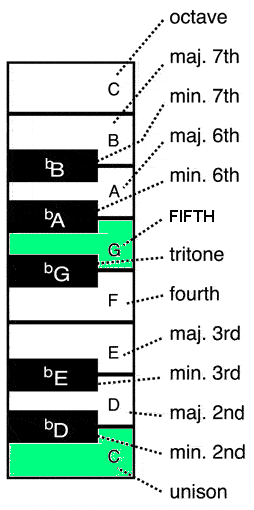
| An interval is the distance between 2 notes. (In the diagram to the right, all the intervals are measured from the low C note.) On a piano, one can have a wide variety of intervals, including what is known as a tritone or devils interval (3 whole steps). In music, the further one gets away from the tonic, the more dissonant the resulting sound will be. The lessons in unit 4 and 5 should really be taken together as there are concepts that truly belong together -- and intervals are just applicable to the Circle of 5ths as they are to scales. The use of tritones is common today, in both pop and jazz. It was avoided for a long time, but has been embraced by modern music and like the VIIth, needs to be resolved. |
 |
The size of an interval is effected by both the key signature and the accidentals
being applied to each note; one must determine how far the upper note and lower note are from each other.
At Dr. Brian Blood's music theory website, intervals have
been inverted and result in a different sized interval, for the inversion changes the distance between each of the notes. His "Rule of 9" is a
good way to determine intervals larger than a fourth (that includes the tritone, the first interval that is above the fourth).
This interval comes up in conversation quite a few times -- and is often used, even though some do not know the name that
refers to the concept.