Lesson 6: Time Signatures
As discussed at Brian Blood's website,
music is composed of strong beats and weak beats. The first beat is always strong
and is followed by a weaker beat. In 4/4 time, the beats follow a
Strong
Weak
Medium
Weak
pattern and in 3/4 time, the pattern is
Strong
Medium
Weak.
The instruments commonly known for maintaining a sense of rhythm are the bass & drums. They often
repeat the same pattern, and often have notes that fall on strong beats. In
Lucy In The Sky With Diamonds,
the bass notes fall on the strong beats, and enter the music after the Lowery Organ
riff. The song changes to cut time or
alla breve in the chorus (2/2).
Many songs that are written have a 4/4 meter, and sometimes the meter of a song can change. In Lucy In The Sky With Diamonds, the meter changes from 3/4 to 2/2 at 0:48 (note the use of drums to establish the new meter.) At the end of the 2/2 meter, the bass re-establishes the 3/4 meter that is used in the verse. During the alla breve section (0:48 - 1:07), the tempo speeds up. The meter of this Lennon & McCartney song changes several times. In addition to the choice of meter, the choice of instruments can have a profound effect upon the feel of a piece of music. Meter, tempo and instrumentation all work together to form movement.
Many songs that are written have a 4/4 meter, and sometimes the meter of a song can change. In Lucy In The Sky With Diamonds, the meter changes from 3/4 to 2/2 at 0:48 (note the use of drums to establish the new meter.) At the end of the 2/2 meter, the bass re-establishes the 3/4 meter that is used in the verse. During the alla breve section (0:48 - 1:07), the tempo speeds up. The meter of this Lennon & McCartney song changes several times. In addition to the choice of meter, the choice of instruments can have a profound effect upon the feel of a piece of music. Meter, tempo and instrumentation all work together to form movement.
The three common time signatures in music are 4/4, 3/4 and 2/4. The upper number indicates how many beats there are in a
bar and the lower number indicates the type of note that is the unit of measure for that bar (8 = eighth note, 4 = quarter note and
2 = half note). The same amount of time passes in a 6/8 measure as a 3/4 measure, and twice as much time passes in a
4/4 measure than a 2/4 measure. As shown below, beats occur at regular intervals.
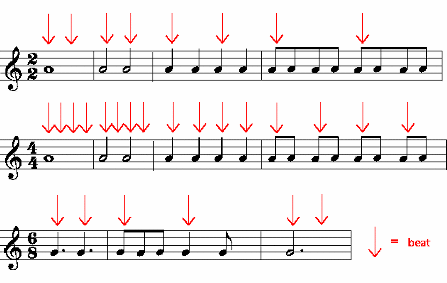
In the second 6/8 measure, there is a triplet (first three notes) that lasts one beat. This tuplet is commonly used in music and essentially slows down the rhythm that is occurring. In Lennon & McCartney's song There's A Place, triplets occur in the vocals at 0:23, 0:26 and 0:52. Groups of 3 equal notes are derived from compound time signatures, and the three 6/8 measures are displayed in 3/4, 2/4 and 4/4 as follows (the tempo changes accordingly to equalize the timing = 4.5 seconds):
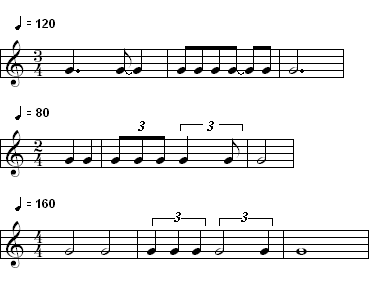
In written music, there are a wide variety of time signatures; some have 2 beats per measure, some have 3 beats per measure and some have 4 beats per measure. The most common signatures in use are 3/4, 4/4, 6/8 and 12/8. Most published music uses these time signatures. The important thing to remember is that dotted notes receive one beat in compound time. A dotted quarter note lasts just as long as three eighth notes. In 2/4 and 4.4, triplets are groups of three notes borrowed from compound time signatures. A quarter note triplet lasts as long as 1 half note and a eighth note triplet lasts as long as 1 quarter note.
In the second 6/8 measure, there is a triplet (first three notes) that lasts one beat. This tuplet is commonly used in music and essentially slows down the rhythm that is occurring. In Lennon & McCartney's song There's A Place, triplets occur in the vocals at 0:23, 0:26 and 0:52. Groups of 3 equal notes are derived from compound time signatures, and the three 6/8 measures are displayed in 3/4, 2/4 and 4/4 as follows (the tempo changes accordingly to equalize the timing = 4.5 seconds):
In written music, there are a wide variety of time signatures; some have 2 beats per measure, some have 3 beats per measure and some have 4 beats per measure. The most common signatures in use are 3/4, 4/4, 6/8 and 12/8. Most published music uses these time signatures. The important thing to remember is that dotted notes receive one beat in compound time. A dotted quarter note lasts just as long as three eighth notes. In 2/4 and 4.4, triplets are groups of three notes borrowed from compound time signatures. A quarter note triplet lasts as long as 1 half note and a eighth note triplet lasts as long as 1 quarter note.