Lesson 1: Pitch Names
This site is about music that is written down -- and that can be read by those familiar with its "language" of
symbols and visual representations. Learning to read/write music is a skill that has many communicative elements,
that collectively informs how the music is to be played and the time each sound receives. Music is a collection of
sounds played together or one after the other; some notes last a short while, some last longer. Computerized music
involves turning a note ON and then turning it OFF. As noted below, notes have pitch and duration. Rests, on the
other hand, only involve duration (i.e the absence of sound).
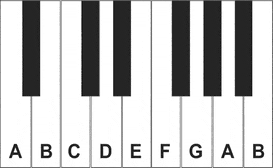
| The first seven letters of the alphabet are used to represent different pitches (or notes). On a piano, these are repeated one after the other in the same order. Thus, the first 7 white keys on the piano section on the left side are A, B, C, D, E, F and G. The first 15 keys of a piano are shown, of which 9 are white and 6 are black. The white keys correspond to the following pitches: A0, B0, C1, D1, E1, F1, G1, A1 and B1. The number following each pitch is the octave that the pitch belongs to. |
|
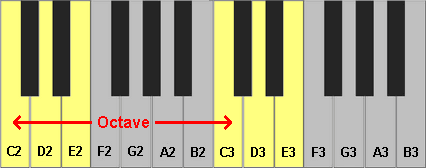
On a piano, keys are organized in repeated sections of white and black keys; one has 5 keys in it and the other
has 7 keys. Together, these 12 keys span nearly an octave. C2 to B2 is not an octave apart, but C2 to C3 is. Each time, one
reaches a higher C note, the number associated with the pitch increases. G2 to G3 is also octave apart.
In music, an octave spans 6 whole tones (WT) or 12 half-tones (HT). On a piano, a half-tone (or semitone) is the smallest distance between two notes. The distance between E & F, as well as B & C is a semitone. As shown below, two semi-tones is the same distance as 1 whole tone. Count the number of keys that are above or below the note you start from. The concepts of a half-step and whole-step come from ancient Greece and were adopted in Western music, as discussed at Wikipedia. An octave can be divided into 2 tetrachords.
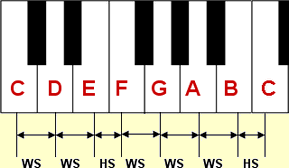
In music, an octave spans 6 whole tones (WT) or 12 half-tones (HT). On a piano, a half-tone (or semitone) is the smallest distance between two notes. The distance between E & F, as well as B & C is a semitone. As shown below, two semi-tones is the same distance as 1 whole tone. Count the number of keys that are above or below the note you start from. The concepts of a half-step and whole-step come from ancient Greece and were adopted in Western music, as discussed at Wikipedia. An octave can be divided into 2 tetrachords.
A piano has around 7 octaves. The first note is A0 at 27.5 Hz and the last one is C8 at a frequency of 4,186.01 Hz. (As shown at
Wikipedia, if a melody jumps an octave, the
frequency of the 2nd note is double that of the first; Middle C is 261.626 Hz and Low C is 130.813 Hz. The green key is Middle C
(C4) and the red key is A or 440.0 Hz (A4), the tuning frequency used in concert bands and orchestras. This is known as
Concert Pitch.
