Lesson 2: Notes & Rests
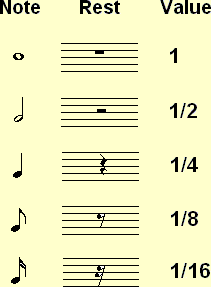
| All notes and rests have a duration determined by their symbol and the tempo used at the time. Whole notes last four times longer than quarter notes and quarter notes last twice as long as eighth notes. The rests that correspond to these notes denote silence for the same amount of time as the notes associated with them. Note the difference in display between a whole rest & half rest. Missing from this listing are 1/32 & 1/64 notes and rests as they do not occur that often. To many people, a "beat" is one quarter note. It often occurs in music written for beginners, and even appears frequently in popular music. |
|
Shown below are whole notes, half notes, quarter notes and eighth notes. In a piece of music, notes are aligned vertically so that
all notes occurring line up properly time-wise -- in relation to other adjacent notes. If there are any, even rests must be
aligned properly. In addition, it better to use one whole rest than 2 half rests -- or one half rest than two quarter rests. If a
dot appears at the end of a note or rest, it is extended by 1/2 its value. A dotted half note lasts three beats. Dotted quarter
notes are quite common.
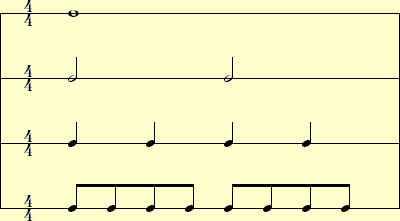
The relative values of quarter notes, eighth notes and sixteenth notes are shown below. Four quarter notes are equal to one whole note and eight eighth notes are equal to 4 quarter notes. In most music, one will not necessarily hear repetitions of the same notes, as rhythm takes various shapes and form. Melody, harmony and rhythm work together to form something of interest. Hearing the same patterns (or usage of notes/chords) too much leads to monotony. In music, rests are especially important as too many notes creates clutter. In music, it is often better to use less than more. Some composers even use partial chords or 5ths.
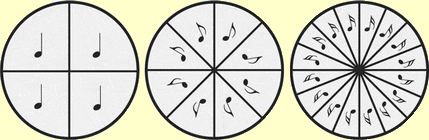
The relative values of quarter notes, eighth notes and sixteenth notes are shown below. Four quarter notes are equal to one whole note and eight eighth notes are equal to 4 quarter notes. In most music, one will not necessarily hear repetitions of the same notes, as rhythm takes various shapes and form. Melody, harmony and rhythm work together to form something of interest. Hearing the same patterns (or usage of notes/chords) too much leads to monotony. In music, rests are especially important as too many notes creates clutter. In music, it is often better to use less than more. Some composers even use partial chords or 5ths.