Lesson 7: Rhythm
The standard method for counting out rhythms has been taught to many people
(including myself), but it isn't the only method that can be used. Another alternate method is shown
below it. Note the use of words that have the same rhythm as their respective notes. Many people (including myself) who
learnt to read music for band classes have been taught rhythms with the first method, but this method is not the only one
that can be used to teach how long to hold each note.
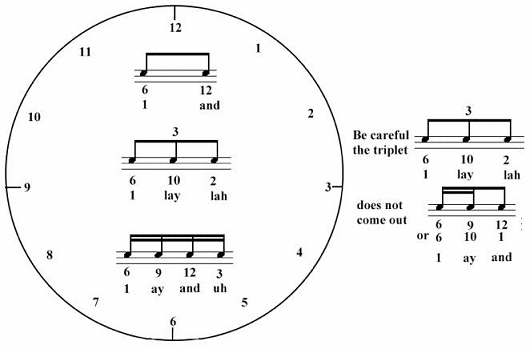
With respect the diagram shown below, start the first beat at 6 o'clock and make one full circle per beat. Note when your circling goes past 12 (duple division or 1/2 beat), 6, 9, 12, 3 (quadruplet division or 1/4 beat) and 6, 10, 2 (triplet division or 1/3rd beat). As with the first method. count half beats as "1 and", 1/4 beats as "1 e and a" and triplets as "1 lay lah". If it's a triplet in a 1/2 or 1/4 division, make sure the triplet is even at 6, 10, 2 on the clock. It is important to recognize where each beat falls and which notes are part of that beat. There are rhythmic divisions in written music.
To improve one's sense of rhythm, Listening to music is also necessary, in addition to reading the way it is notated musically. With computer music, the instruments are artificial & can be generated using soundfonts. The quality of the sounds generated, and the tones produced by each virtual instrument, are just as important as with the real instruments. The virtual instruments presented at Sounds Online were all sampled from real instruments, just like the instruments I used in In My Life. Whereas the latter uses soundfonts, the former is a software virtual instrument -- that could be re-sampled (i.e. recorded) to produce a soundfont.
Rhythm is an integral part of music and many well melodies are built upon such rhythms. A good example is Dave Brubeck's Take Five. Provided here are both backing instrumentation and the original recording of the composition. Even though they are repetitive, without the rhythms that drive the song forward, the song would not be the same -- and somewhat lifeless.
Dave Brubeck Quartet
Backing Track
Piano Cover
The melody is well known, and the underlying rhythm is never missing (the two go together). With respect to pop, compare the following two recordings (A Shot Of Rhythm & Blues / I Saw Her Standing There) and ask yourself this question: "What did Lennon & Paul McCartney base their song's rhythm on?" Though not exactly alike, there are similarities. Lennon & McCartney are known for taking an entire song's chord progression and adapting it to their own use. In 1962, they altered Twist & Shout and their version sticks out in people's minds today -- even though the original is also available.
With respect the diagram shown below, start the first beat at 6 o'clock and make one full circle per beat. Note when your circling goes past 12 (duple division or 1/2 beat), 6, 9, 12, 3 (quadruplet division or 1/4 beat) and 6, 10, 2 (triplet division or 1/3rd beat). As with the first method. count half beats as "1 and", 1/4 beats as "1 e and a" and triplets as "1 lay lah". If it's a triplet in a 1/2 or 1/4 division, make sure the triplet is even at 6, 10, 2 on the clock. It is important to recognize where each beat falls and which notes are part of that beat. There are rhythmic divisions in written music.
To improve one's sense of rhythm, Listening to music is also necessary, in addition to reading the way it is notated musically. With computer music, the instruments are artificial & can be generated using soundfonts. The quality of the sounds generated, and the tones produced by each virtual instrument, are just as important as with the real instruments. The virtual instruments presented at Sounds Online were all sampled from real instruments, just like the instruments I used in In My Life. Whereas the latter uses soundfonts, the former is a software virtual instrument -- that could be re-sampled (i.e. recorded) to produce a soundfont.
Rhythm is an integral part of music and many well melodies are built upon such rhythms. A good example is Dave Brubeck's Take Five. Provided here are both backing instrumentation and the original recording of the composition. Even though they are repetitive, without the rhythms that drive the song forward, the song would not be the same -- and somewhat lifeless.
Dave Brubeck Quartet
Backing Track
Piano Cover
The melody is well known, and the underlying rhythm is never missing (the two go together). With respect to pop, compare the following two recordings (A Shot Of Rhythm & Blues / I Saw Her Standing There) and ask yourself this question: "What did Lennon & Paul McCartney base their song's rhythm on?" Though not exactly alike, there are similarities. Lennon & McCartney are known for taking an entire song's chord progression and adapting it to their own use. In 1962, they altered Twist & Shout and their version sticks out in people's minds today -- even though the original is also available.