

Chord Progressions
This site is for music students and their teachersWritten around January 1959, I'll Be On My Way (BBC) is one of Paul's best early compositions, and yet when they released their first record, 'Love Me Do' was used instead. The recording for the BBC was done much later, so there may have been a few modifications to the song itself. Despite the chords being simple, it is the instrumentation and vocals that is more significant.
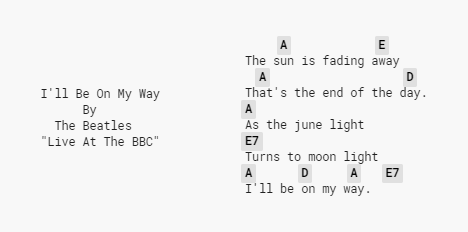
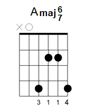
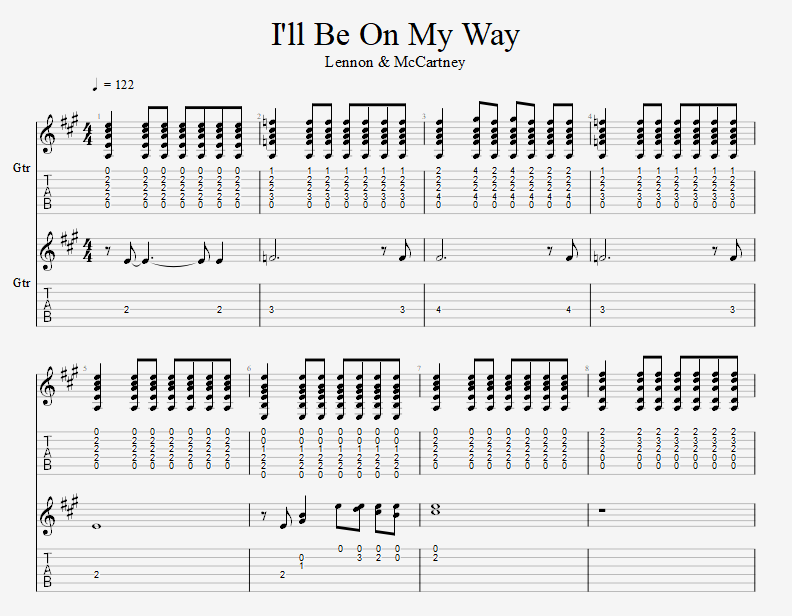
The Beatles often used slight changes in fingerings to create unique sounding openings, like the one at the beginning of this song. In April 1963, it was given to Billy J. Kramer, which is likely one reason it resurfaced.
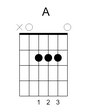

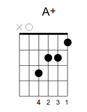
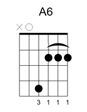
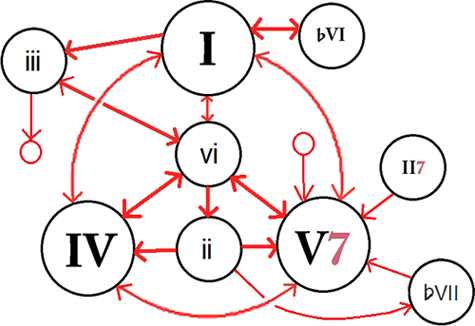
A Revised Chord Progression Diagram
Based on information provided elsewhere on the site, the following progressions are typical of many early Beatles songs. These are diatonic progressions. At times, there are deviations from this, but for the most part, this is how their songs progressed. Between March and April 1962, two songs were added to their repertoire: Ask Me Why (Lennon) and P.S. I Love You (McCartney). They are both diatonic.
Northern Songs
When Lennon & McCartney achieved their first hit with "Please Please Me" in February 1963, Northern Songs, their music publishing company was formed by music publisher Dick James. It was an equal parternship between Dick James, Brian Esptein, John Lennon and Paul McCartney.
Songwriting Formula?
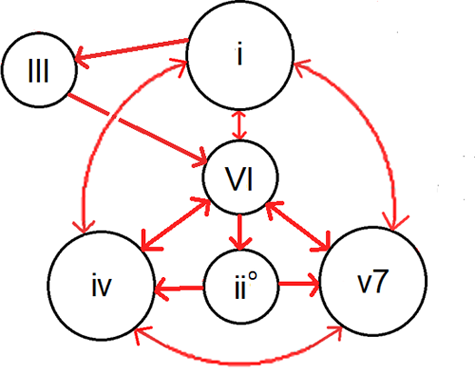
The Beatles used minor 4th (iv) chords in their compositions, in addition to those above. This is something that John and Paul did more so than George. As Jake, at everysoundthereis.com states, "The Beatles swapped out the major IV for a minor iv" at times. It all depended on the chord they were transitioning to. Paul understood classical music better than John, but soon he too was employing such transitions.
In 'Ask Me Why', as Allan Pollack points out, "in measure 11, John's much favored minor iv chord -- i.e. the one borrowed, as it were, from the parallel minor Key of E -- is substituted for the naturally occurring Major IV chord we saw in the same measure of the initial verse."
Songwriters will often switch to using one or more relative minor chords -- instead of their major counterparts -- as found in the progressions found below:
Music Analysis
Since it was written, many people have analyzed the Beatles music, including Allan Pollack. They have not always written hits and many of their songs have never been released, like From A Window and Bad To Me. Many of these unreleased songs, were of course, given to other artists, but they are still Lennon & McCartney compositions. They even gave the Rolling Stones their first hit using 3 simple chords (verse). In the chorus, they introduced F#7 and C#7. They often delayed chords till later.
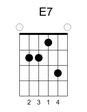
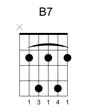
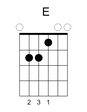
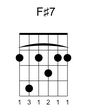
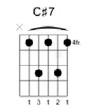
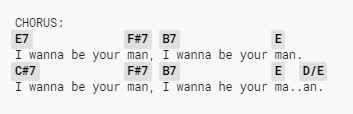
To be unique with regard to their performances, many artists altered the compositions they were given. For interest's sake, look up the name Bernard Webb. McCartney even used the name "A. Smith."
Brian Epstein and The Decca Audition
On November 1961, Brian Epstein became the Beatles' manager and promised to get them a recording contract. That meant that they had audition a selection of their songs -- but for their audition with Decca, they did not choose the songs they played; Epstein did. Ultimately it failed, but at least he had a reel of tape that he could transfer to disc. The recordings, however did not convince George Martin that they were worthy of an EMI recording contract. Their sense of humour, however, did. George Harrison commented on Martin's tie.
"I thought their music was rubbish," Martin told the BBC's Arena programme in 2011. "It wasn't Cliff Richard and the Shadows, that's for sure." Martin invited the band back to the control room and explained, at great length, where he felt they were going wrong. "We gave them a long lecture about their equipment and what would have to be done about it if they were to become recording artists," recalled Norman Smith. At the studio, Martin gave The Beatles the chance to respond to his dressing down. "I've laid into you for quite a long time," he said. "You haven't responded. Is there anything you don't like?" "Well, for a start," replied George Harrison, "I don't like your tie."
The quip broke the ice and The Beatles relaxed into comedy mode. "For the next 15 to 20 minutes they were pure entertainment," recalled Norman Smith. Despite his misgivings, Martin eventually decided The Beatles had "the potential to make a hit record" and gave them a recording deal on 6 June (backdated by two days so as to secure copyright to the recording session). The Beatles were lucky, but still as yet, not out of the woods.
Discover some new chord progressions.
