

Open & Barre Chords
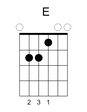
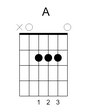
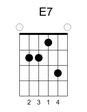
This site is for music students and their teachersAn open chord (open-position chord) is a chord that includes one or more strings that are not fingered. On a regular six-string guitar, an open chord can have from one to six open strings sounding. In contrast, all of the strings are fingered for a barre chord. Of all the chords introduced initially, the following chords are open.
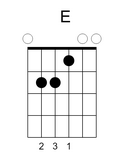
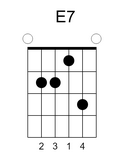
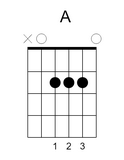
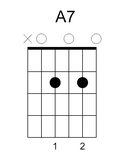
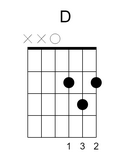
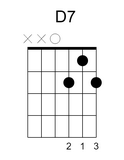
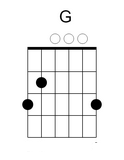
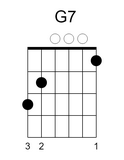
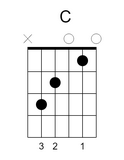
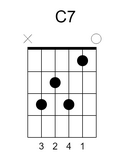
Barre chords are often used as they allow one to form movable chords like F, F#7 and even G (366433). Whether one uses an open or barre chord really depends on the composition, but regardless there needs to be an easy way to transition from chord to chord. One chord that is often used by the Beatles to do so is G6 as it is open. Often referred to as a passing chord, not all of the strings are necessarily played.
Rhythm
The only two rhythms that one needs to note/learn are the quarter note and 2-eighth note patterns. As shown in the next diagram, one quarter note is equal in duration to two eighth notes (red area).
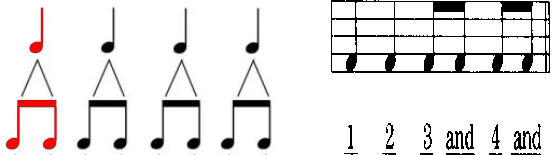
A lot of music books will display notes that are part of a measure, but it is my contention that the Beatles would have only paid attention to the rhythms that they heard. They focused on what the song sounded like and attempted to reproduce it. Inevitably, things fell into place beat by beat ( 1 2 3 4 | 1 2 3 ... ).
April - June 1957
Between April-June 1957, the Beatles had the opportunity to hear and emulate at least 10 songs:
- Twenty Flight Rock
- Come Go With Me
- Too Much Monkey Business
- Roll Over Beethoven
- Fabulous
- Rip It Up
- Baby, Let's Play House
- Young Blood
- I Wonder If I Care As Much
- Searchin'
The Day Paul McCartney Met John Lennon
During the Woolton Parish Church Garden Fete that took place on July 6, 1957, the Quarrymen played at least three compositions:
- Puttin On The Style
- Baby, Let's Play House
- Come Go With Me
When Paul McCartney met John Lennon in the church hall after the concert, he played Twenty Flight Rock using power chords: A5, D5 and E5. He had heard (and likely slowed down) the recording in April -- and had seen the movie that Eddie Cochran was in: The Girl Can't Help It. As he was left-handed, he had to the play the guitar he borrowed upside down. It was his vocals that impressed Lennon -- and the fact that he could tune a guitar -- as it had banjo tuning at the time.
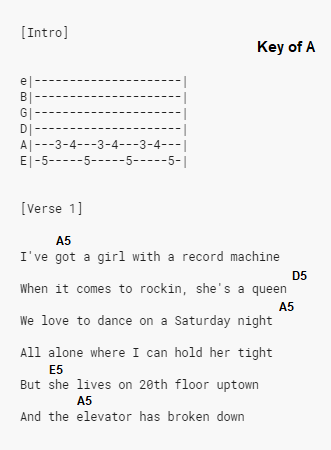
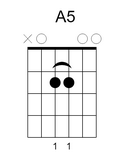
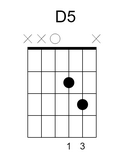
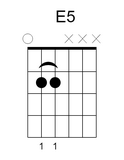
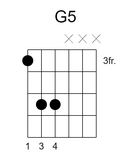
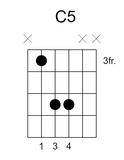
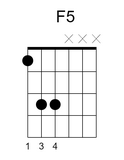
These open chords are commonly referred to as 'Power Chords.' They are a special type of chord commonly used in Rock'n'Roll. Adding them to one's repertoire is worthwhile. All the power chords that John and Paul would have learned are shown below (including A5, D5 and E5):
Their Idol: Elvis Presley
Both Paul and John found that they had things in common: A love for Elvis Presley and his music. They both knew the chord progression to the song Baby, Let's Play House, as well as its words.

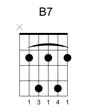
When one creates a composition, one has to have passion. When John Lennon and Paul McCartney decided to start writing music, they knew what was important: using the RIGHT chords at the RIGHT time. Almost immediately, they decided to reserve certain chords for the middle eight.
Song Structure & The Circle of 5ths
John Lennon and Paul McCartney were very much aware of the song structure they decided to use. Even though they didn't know what the Circle of 5ths was, they quickly mastered use of chords associated with it. Chord progressions are based on the key in use (commonly E, A, D, G or C).
In August 1957, Elvis Presley was at the top of the charts with Mean Woman Blues. The chords were known to both Lennon & McCartney -- and like many other songs, they were soon playing this song as well, REPEATING chord patterns associated with the vocals. They recognized what parts of the song repeated themselves.
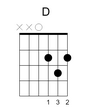
Even without more accurate references, the Beatles managed to copy a lot of songs, merely by how often they played them. The Beatles played cover songs repeatedly right up until 1964. Most of the songs were centered around the I, IV and V areas (tonic, subdominant and dominant), like in the key of A major.
Some songs like And I Love Her modulated to another key on the circle of 5ths (E major to F major), but this tendency did not often occur. Most songs stayed in one key. Sometimes, however, the Beatles would modulate to the subdominant key. In I Want Hold Your Hand, they modulated from G to C during each middle 8.
Discover some new chord progressions.
