
Scales
Using tetrachords, a wide variety of scales can be produced, and even new chords can result based on use of the intervals between each note. Many musicians make use of the chords and intervals that are applicable to each mode or scale. Notes that are part of a mode/scale can be harmonized in many ways. Usually, every other note is used to avoid dissonance. On the other hand, sometimes notes that produce dissonance, as opposed to consonance, ARE used. Compositions move away from and towards the tonic key (the further away that a key signature's notes are from the tonic scale, the more dissonance there is).All scales and chords have a Root (R) note that is the first note of the Tonic chord -- and the first note of the associated scale. As seen below, the A Root has 1 major scale and 3 minor scales associated with it. These are the scales derived from the Ionian and Aeolian modes -- with exception of the last two scales. The harmonic and melodic minor scales resulted due to composers not being satisfied with the two former scales -- and these scales were modified to satisfy what was heard. The intervals between the notes at the end of the scales was of significance.
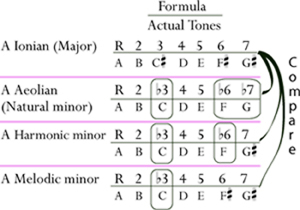
Note that the seventh degree or leading note is only a semitone below the tonic in three of the scales. The term leading note (or leading tone) is a good description of the melodic/harmonic function that this note -- and chord built upon it has. The leading note resolves or 'leads' to the tonic. Voice leading is important in music and the notes of a chord are often written so that note movement is minimized. Because there is a need to resolve the harmonic "tension" heard with chords built upon the VII degree, it is referred to as having a leading melodic/harmonic function. Melody, or use of scales, is not developed in isolation of harmony. The two are intimately linked and are often developed together when a piece of music is composed.
© 2013 -- Reed Music Publications