If one searches through the internet, one can find a wide variety of diagrams that attempt to explain pictorially
what is applicable to music theory, compositions and the composers who write them. Many are related to
guitars, rock music and jazz -- as well as classical music. Of all of these diagrams, the Circle of 5ths is perhaps
the most significant and something that one can expand upon in many ways. I began this website by creating
a set of circles, all associated with different chord changes -- and dropped use of them. One can go far beyond
what is in this website and there is a link at the bottom just for this purpose. No website on Music Theory will
ever be complete. One will, inevitably, draw upon outside sources. Learning about music should end with just
one website. It is impossible to cover everything and sometimes concepts are left out, like tritone substitution. (This is a
concept related to Jazz composition.)
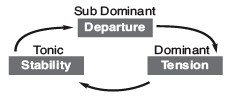
Music moves away from and towards the tonic home key. As shown
below, it tends to move to the subdominant key and then to the dominate key.
One should look at a specific area of the
Circle of 5ths and restrict where a composition can move to
(i.e. which keys). Common chord progressions in G major are G - C - Am - D - G
(I - IV - ii - V - I) and G - Em - Bm - D - G (I - vi - iii - V - I). These
chord progressions are based on the G major scale (G A B C D E F# and G).
When one looks at the circle of 5ths, on should concentrate on the tonic home key and its adjacent neighbours (the IV and V keys are closest -- and the least dissonant choices). Movement in a piece of music often will go outside these bounds, but the departure is usually only momentary unless the key signature itself changes. At times, these rules for harmonic movement can be broken, but one has to consider how this will effect movement overall. There are many possibilities available when referring to the Circle of 5ths, but not all will produce melody/harmony that are pleasant to the ear. Grating sounds can sometimes occur.
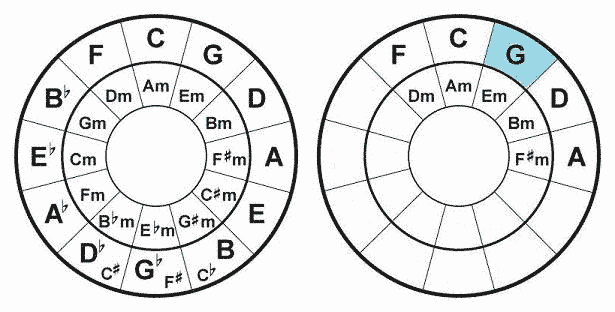
Major: I = G, II = A, IV = C, V = D, VIIb = F (Purple)
Minor: ii = Am, iii = Bm, v = Dm, vi = Em, vii = F#m or F# dim (blue)
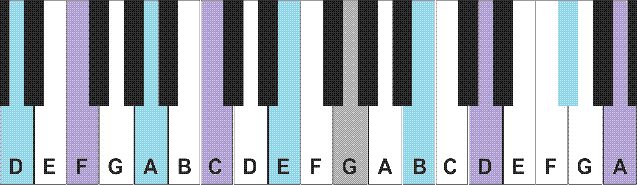
In music, use of flattened VII chords are common. The chord progressions used largely depend on the key signature and the choice of instruments. In All My Loving, use of the D chord (or -VII) is used as an approach the B7 dominant chord. (The VIIb chord can be substituted for the vii diminished chord.) Not all movements will immediately lead back to the tonic. How the composer leads the listener there is a matter of choice -- all within a defined song structure. Before a section of music ends (8, 12 or 16 measures), the tonic is usually reached so that the song's home key is stabilized (akin to "health" going down when one is away from it).
When one looks at the circle of 5ths, on should concentrate on the tonic home key and its adjacent neighbours (the IV and V keys are closest -- and the least dissonant choices). Movement in a piece of music often will go outside these bounds, but the departure is usually only momentary unless the key signature itself changes. At times, these rules for harmonic movement can be broken, but one has to consider how this will effect movement overall. There are many possibilities available when referring to the Circle of 5ths, but not all will produce melody/harmony that are pleasant to the ear. Grating sounds can sometimes occur.
Major: I = G, II = A, IV = C, V = D, VIIb = F (Purple)
Minor: ii = Am, iii = Bm, v = Dm, vi = Em, vii = F#m or F# dim (blue)
In music, use of flattened VII chords are common. The chord progressions used largely depend on the key signature and the choice of instruments. In All My Loving, use of the D chord (or -VII) is used as an approach the B7 dominant chord. (The VIIb chord can be substituted for the vii diminished chord.) Not all movements will immediately lead back to the tonic. How the composer leads the listener there is a matter of choice -- all within a defined song structure. Before a section of music ends (8, 12 or 16 measures), the tonic is usually reached so that the song's home key is stabilized (akin to "health" going down when one is away from it).
The choice of chords in a song is largely dictated by the key
signature used and applicable movement on the Circle of 5ths. The Beatles
learnt to compose and play music without reference to much any music theory,
but their progressions DO fall within the limits that are part of the Circle of
5ths. Helped by their producer who was trained classically as an oboe player,
some of their knowledge can be attributed to him, but they did copy music that
had well established patterns -- all within the IV- I - V area. They tended to
break rules just as much as any other artist. For those interested in their
music, it has been analyzed many times. The analysis by
KG Johanssson is a good
reference to their work. They tended to use the Key of E and the Key of G.
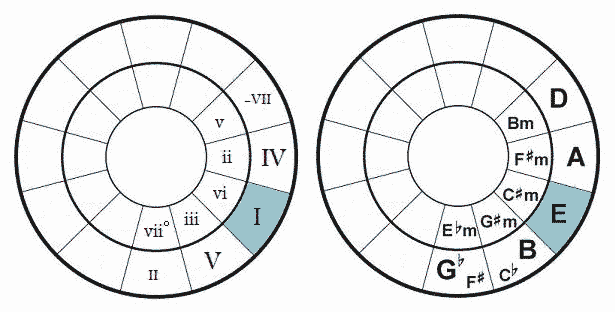
Songs in the Key of E often use the following chords: E (I), A (IV), and B7 (V)
The next chords that one should learn are known as Secondary Dominants and this is where I will leave you. Wikipedia also has information related to these types of chords. Last of all, those interested in teaching compositions should check out Mozart's K. 545 Piano Sonata No. 16, written in 1788. It was not published until 1805. It has three movements (Allegro, Andante and Rondo). An analysis of Sonata can be found at Brandy N. Gerber's Musical Insight webpage. Audio of the 1st movement can be found on You Tube.
Songs in the Key of E often use the following chords: E (I), A (IV), and B7 (V)
The next chords that one should learn are known as Secondary Dominants and this is where I will leave you. Wikipedia also has information related to these types of chords. Last of all, those interested in teaching compositions should check out Mozart's K. 545 Piano Sonata No. 16, written in 1788. It was not published until 1805. It has three movements (Allegro, Andante and Rondo). An analysis of Sonata can be found at Brandy N. Gerber's Musical Insight webpage. Audio of the 1st movement can be found on You Tube.