This site is about music that is written down -- and that can be read by those familiar with its "language" of
symbols and visual representations. Learning to read/write music is a skill that has many communicative elements,
that collectively informs how the music is to be played and the time each sound receives. Music is a collection of
sounds played together or one after the other; some notes last a short while, some last longer. Computerized music
involves turning a note ON and then turning it OFF. As noted below, notes have pitch and duration. Rests, on the
other hand, only involve duration (i.e the absence of sound).
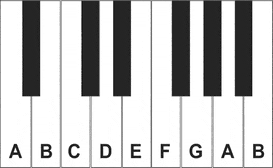
| The first seven letters of the alphabet are used to represent different pitches (or notes). On a piano, these are repeated one after the other in the same order. Thus, the first 7 white keys on the piano section on the left side are A, B, C, D, E, F and G. The first 15 keys of a piano are shown, of which 9 are white and 6 are black. The white keys correspond to the following pitches: A0, B0, C1, D1, E1, F1, G1, A1 and B1. The number following each pitch is the octave that the pitch belongs to. |
|
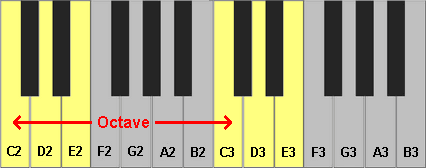
On a piano, keys are organized in repeated sections of white and black keys; one has 5 keys in it and the other
has 7 keys. Together, these 12 keys span nearly an octave. C2 to B2 is not an octave apart, but C2 to C3 is. Each time, one
reaches a higher C note, the number associated with the pitch increases. G2 to G3 is also octave apart.
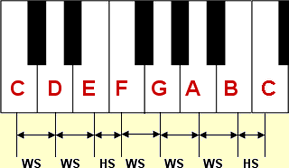
In music, an octave spans 6 whole tones (WT) or 12 half-tones (HT). On a piano, a half-tone (or semitone) is the smallest distance between two notes. The distance between E & F, as well as B & C is a semitone. As shown below, two semi-tones is the same distance as 1 whole tone. Count the number of keys that are above or below the note you start from. The concepts of a half-step and whole-step come from ancient Greece and were adopted in Western music, as discussed at Wikipedia. An octave can be divided into 2 tetrachords.
In music, an octave spans 6 whole tones (WT) or 12 half-tones (HT). On a piano, a half-tone (or semitone) is the smallest distance between two notes. The distance between E & F, as well as B & C is a semitone. As shown below, two semi-tones is the same distance as 1 whole tone. Count the number of keys that are above or below the note you start from. The concepts of a half-step and whole-step come from ancient Greece and were adopted in Western music, as discussed at Wikipedia. An octave can be divided into 2 tetrachords.
A piano has around 7 octaves. The first note is A0 at 27.5 Hz and the last one is C8 at a frequency of 4,186.01 Hz. (As shown at
Wikipedia, if a melody jumps an octave, the
frequency of the 2nd note is double that of the first; Middle C is 261.626 Hz and Low C is 130.813 Hz. The green key is Middle C
(C4) and the red key is A or 440.0 Hz (A4), the tuning frequency used in concert bands and orchestras. This is known as
Concert Pitch.

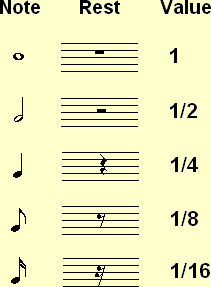
| All notes and rests have a duration determined by their symbol and the tempo used at the time. Whole notes last four times longer than quarter notes and quarter notes last twice as long as eighth notes. The rests that correspond to these notes denote silence for the same amount of time as the notes associated with them. Note the difference in display between a whole rest & half rest. Missing from this listing are 1/32 & 1/64 notes and rests as they do not occur that often. To many people, a "beat" is one quarter note. It often occurs in music written for beginners, and even appears frequently in popular music. |
|
Shown below are whole notes, half notes, quarter notes and eighth notes. In a piece of music, notes are aligned vertically so that
all notes occurring line up properly time-wise -- in relation to other adjacent notes. If there are any, even rests must be
aligned properly. In addition, it better to use one whole rest than 2 half rests -- or one half rest than two quarter rests. If a
dot appears at the end of a note or rest, it is extended by 1/2 its value. A dotted half note lasts three beats. Dotted quarter
notes are quite common.
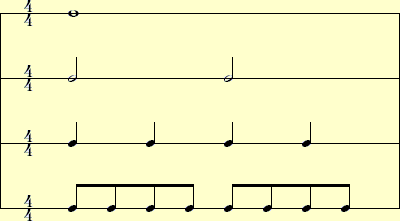
The relative values of quarter notes, eighth notes and sixteenth notes are shown below. Four quarter notes are equal to one whole note and eight eighth notes are equal to 4 quarter notes. In most music, one will not necessarily hear repetitions of the same notes, as rhythm takes various shapes and form. Melody, harmony and rhythm work together to form something of interest. Hearing the same patterns (or usage of notes/chords) too much leads to monotony. In music, rests are especially important as too many notes creates clutter. In music, it is often better to use less than more. Some composers even use partial chords or 5ths.
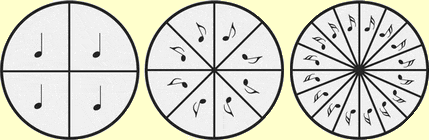
The relative values of quarter notes, eighth notes and sixteenth notes are shown below. Four quarter notes are equal to one whole note and eight eighth notes are equal to 4 quarter notes. In most music, one will not necessarily hear repetitions of the same notes, as rhythm takes various shapes and form. Melody, harmony and rhythm work together to form something of interest. Hearing the same patterns (or usage of notes/chords) too much leads to monotony. In music, rests are especially important as too many notes creates clutter. In music, it is often better to use less than more. Some composers even use partial chords or 5ths.