Music has not always be written the same way. As stated at Gabriella Scelta's
Music Symbol site,
by the 1700s, the use of a five line staff to write music was firmly established. According to
Exploring The Arts Foundation,
the use of a 4 line staff appeared in the 10th century and a system of fixed note lengths arose in the 14th century.
"Vertical bar lines that divide the staff into sections appeared in the 15th century. By the early 16th century,
notation had assumed much of its modern form, with the essential components of staff, clef, Time signature and durational
values, though bar lines only gradually became widespread during the 16th and 17th centuries as an aid in ensemble
performance. Regular measures (bars) became commonplace by the end of the 17th century." Music today is still evolving
and practices used in Western Music have been adopted by all musicians worldwide. Modern music evolved from
plainsong notation.
|
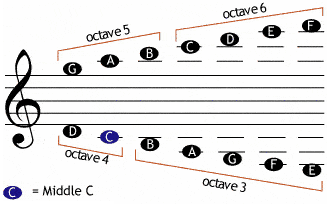
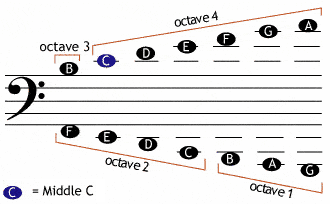
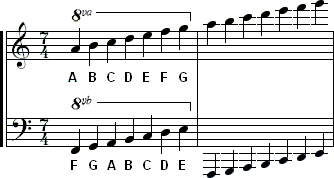
Notes are not just displayed on the 5 lines and 4 spaces of each clef. As illustrated on the right, the use of
ledger lines above and below each staff or
grand staff is also used. In the example
to the right, 8va means that notes are played an octave higher and 8vb means that notes are played one octave lower. The use of
ledger lines to represent notes above staffs occurs frequently and can be determined by how many lines are shown above or below
the staff. Middle C is generally written on a ledger line and can be shown above the bass clef, below the treble clef or between
them on a grand staff. Not all instruments make use of the grand staff. Some use just the bass or treble clef. Choirs generally
make use of a C clef.
|
|
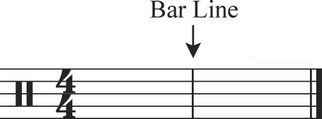
In the fifteenth century bar lines were introduced, dividing written music into bars or measures. These are two terms commonly used
to define rhythm within music. Many people
who can't read music will refer to the number of "beats" in a measure -- and this itself, is determined by the
time signature used in piece of music. 4/4 is commonly
used and has strong beats and weak beats, as illustrated at Brian Blood's
website.