Welcome to Das U-Boot Site
During World War II, German sailors suffered the most loss of all military units in the Third Reich. Of those who manned such vessels, 3/4 never returned. Living aboard a u-boat was not only isolating, but confining as well. "No other vessel of war presented poorer living conditions than that of a U-boat. Each war patrol could take anywhere between three weeks to six months. During this time, U-boat crews were not able to bathe, shave or change their clothes." (Uboataces).It was like living in rooms full of dials ... within a floating machine.
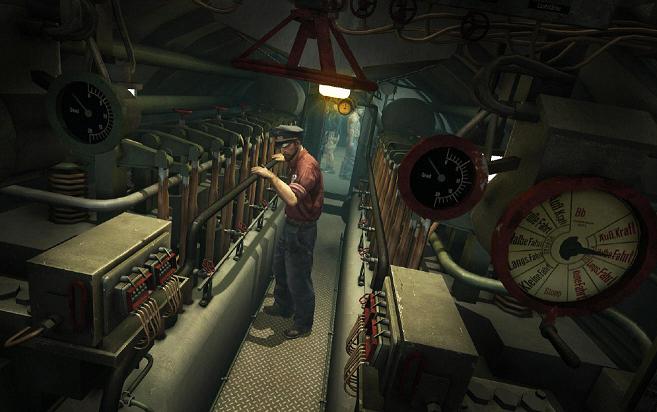
Underwater, the deeper a u-boat went, the more it's hull was crushed -- leading to internal leaks within the vessel. As allied vessels passed overhead, use of ASDIC could often be heard (0:23). Keeping sound to a minimum was important, for it could easily be heard by both sides in any conflict. Unwanted sound was undesirable, especially that from malfunctioning equipment (e.g. engines).
The aim of all u-boats under Admiral Dönitz's command was to sink all major convoys en-route from the United States to Britain, for it would provide an advantage to axis powers. Both sides were engaged in a game of cat and mouse -- and from 1939-42, Germany sank a lot of of critical tonnage in allied war efforts: food, weapons and fuel. Both sides looked for an advantage, and on May 9, 1941, Britain managed to capture what was giving Hitler the upper hand: an Enigma Machine.
Every ciphered message sent from radio transmitters in Germany/France -- and from the Goliath Transmitter in Kalbe, Germany after 1942 -- were received and deciphered in London's Bletchley Park. Until Germany occupied France, it lacked the powerful radio transmitters needed to communicate with its boats. Using up to 1800 kW of power, Goliath's transmissions could be received worldwide -- including submerged submarines in the Caribbean, but had difficulty penetrating Norwegian fjords.
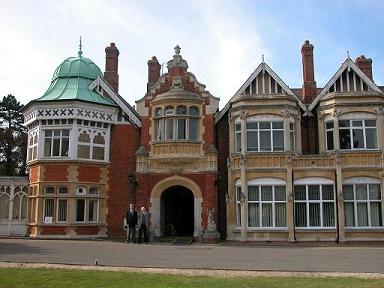
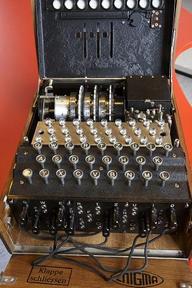
In 1942, the German Navy sent short messages or Kurzsignalen (Short Signal Code) to minimize the duration of transmissions, thereby reducing the risk of being located by direction finding techniques. The messages were only 22 characters long and were used to report sightings of possible Allied targets. It was during 1942, that Germany achieved the highest results using U-boats (452), and for most of the year, U-boat enigma codes were not broken. On October 30, however, yet another U-boat was captured (U-559). "The Enigma material they retrieved was immensely valuable to the code-breakers at Bletchley Park, who had been unable to read U-boat Enigma for nine months. The captured material allowed them to read the cyphers for several weeks, and to break U-boat Enigma thereafter" (Wikipedia). A similar coding system was used for weather reports from U-boats, the Wetterkurzschluessel, (Weather Short Code Book).
Atlantic Theatre: 1941-1945
Unlike the situation at Bletchley Park, the United States armed services did not share a combined cryptana- lytical service. Before the US joined the war, there was collaboration with Britain, albeit with a considerable amount of caution on Britain's side because of the extreme importance of Germany and her allies not learning that its codes were being broken. Despite some worthwhile collaboration amongst the cryptanalysts, their superiors took some time to achieve a trusting relationship -- in which both British and American intelligence was used to mutual benefit. When the bombing of Pearl Harbour occurred, two theatres of operation opened up, causing a strain upon convoy supply to the UK.As re-implemented by Dönitz, U-boats operated in packs -- as they had done during the First World War. In 1937, Dönitz began lobbying to convert the entire German fleet to submarines as he believed that a campaign dedicated to sinking merchant ships could quickly knock Britain out of any future wars. His use of Rudeltaktik or "pack tactic" (commonly referred to as "wolfpack" in English) conflicted with Erich Raeder, who was his superior officer until 1943; Raeder was an advocate of surface attacks. When Raeder resigned in 1943, Dönitz took over both surface and sub-surface warfare in the Atlantic. If it wasn't for the code-breaking done in Bletchley Park, Germany may have cut off a lot of important supplies. In 1939, he only had 57 U-boats -- but more were soon ready for use. To operate in wolfpacks, as explained by Dönitz himself, a lot more submarines would be needed.
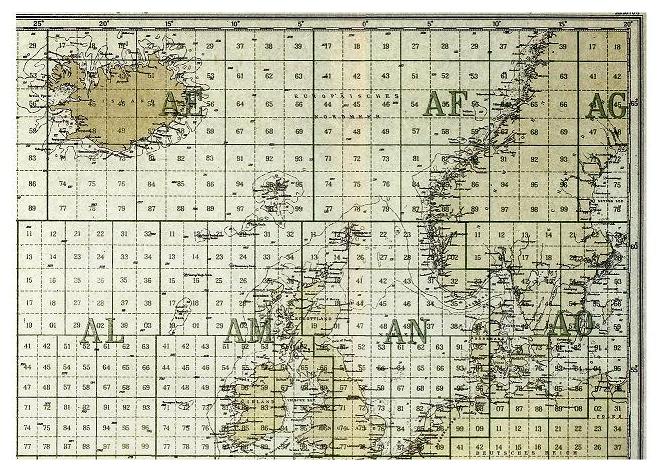
During the War, Germany had two main theatres of operation: those in the West (Atlantic, North Africa, etc.) and those in the East. Many in the German High Command took a blind eye to what was happening on land, but at sea, things were slightly different. Until ordered not pick them up in 1943, Allied crews were rescued by German U-boat crews -- as they felt kinship to those who were also mariners. During the Nuremberg Trial, both Raedar and Dönitz were convicted, but felt that they were not [directly] responsible for revealed atrocities. Many German officers claimed that they were "just carrying out orders." Many in the kriegsmarine (or German navy) blamed outcomes of the war on politicians, claiming that they were the ones mainly making decisions. Irregardless, a lot of people on both sides lost their lives as a result of events in Europe, the Atlantic and Pacific. At the end of the war on April 9, 1945, U-486 departed from Kiel in an attempt to reach Japan. Both nations were losing the war and wished to change the outcome -- but like many other U-boats, it was sunk on April 12. Within a month, all German forces had surrendered in all theatres of war (May 1st to 8th). Upon Hitler's death, from May 1 to May 23, Dönitz was President of the Flensburg Government (Hitler's successor). In his last will and testament, Hitler designated Dönitz as his successor. Dönitz was not to become Führer (a post which Hitler abolished in his will), but rather President (Reichspräsident), a post Hitler had abolished in 1934. At the time, Hitler condemned both Hermann Göring and Heinrich Himmler as traitors and expelled them both from the Nazi Party and the German government.