Use of Enigma
Enigma is the name given to an invention created by German engineer Arthur Scherbius at the end of World War I
(patented in 1928). Early models were used commercially during the 1920s, and adopted by military and government
services of several countries - most notably by Nazi Germany before and during World War II. The German Navy
(Kriegsmarine) adopted it in 1926. Other branches of the military adop- ted it a few years later. Scherbius died
in 1929, so he never witnessed use of Enigma during WWII.
During the war, the use of radio communication to transmit Morse code that had been encrypted was widespread and used by all the axis powers. Even the allied powers made use of decrypted messages. On the German side, the officers of the B-Dienst (Observer Service) used wireless intercepts and decrypts of cipher transmissions to establish convoy positions and read their orders; on the British (later anglo-American) side, the cryptographers of the Government Code and Cipher School at Bletchley and the staff of the Admiralty Operational Intelligence Centre monitored the signals sent from Dönitz's headquarters at Kernevel, Lorient (after March 1942, Berlin), to detect the formation of patrol lines and vectoring of wolfpacks against their targets. Rerouting was by far, the most successful of convoy protection measures.
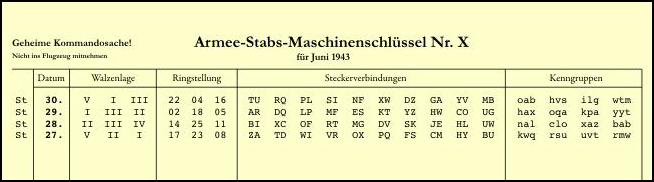
Between 1939-1945, the German High Command (Oberkommando) did not use the same daily keys (see below) as did the ordinary German Army. That way the Germans prevented information addressed for one part of the military to be read by other parts of the German military. That is one reason why soldiers, including naval officers, were unaware of many events unfolding in central Europe, and some things only became apparent to members of the Reich during the Nuremberg Trials. Many did not want to face, or witness what had occurred and claimed that they had nothing to do with it -- and that Hitler was to blame. Communication between different military groups was kept private to only those associated with the transmission. Shown below is the army "Maschinenshlüssel. The code sheets used by the Navy were similar.
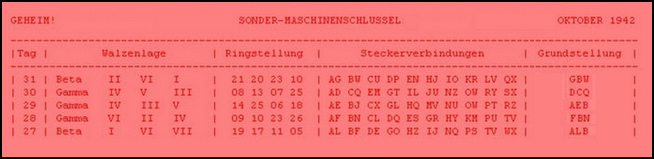
The Navy's codebook was printed in red ink and was water soluble just in case the u-boat was sunk. It was also printed on red paper. Those who used this codebook had to be careful not to get it wet.
"During the Second World War the German U-boats used Kurzsignale or Short Signals to send their messages. The Kurzsignale were an important part of the complex Kriegsmarine communications system. In general, the Kurzsignale were four letter groups representing all kinds of sentences regarding tactical information such as course, enemy reports, position grids or weather reports" (Kurzsignale). Each day the code in use (or Grundstellung) changed at midnight. Other branches, like the army, changed every 6 - 12 hours.
In any message, the last 3 letters of the 1st 4 or 5 character word indicated the Grundstellung deciphering key. This five letter word was not enciphered. For June 29, the codes in use were: HAX, OQA, KPA and YYT. Next, the message followed: ???? ???? ????, and was enciphered. Next, a three character enciphered code for the respective U-boat was used, followed again by the non-enciphered key. In the Navy this coded message was proceeded by a ß ß (beta beta) introduction code. The total transmission was 22 characters.
Between 1939-1945, there were four alphabetic wheels in use by the Navy. The first was an alpha/beta reflector wheel as shown below (6) -- and this was determined by a codebook. The other three wheels were the ones that rotated (akin to Hours, Minutes and Seconds). Each of the branches had wired wheels to choose from. The first five rotors introduced (I-V) contained one notch each, while the additional naval rotors VI, VII and VIII each had two notches per rotation. Their letter wirings were further scrambled by use of plugs during the war, as shown above: For June 29, A -> R, D -> Q, L -> P etc., as well as in reverse (R -> A, Q -> D, P -> L). By exploiting repeated messages about the weather and procedural errors made during transmission -- as well as other factors, those at Bletchley Park proved that some of the enigma codes could be broken. The number of permutations, as viewed at Cracking the NAZI Enigma Code Machine covers this subject in detail. Use of mathematics helped to crack the ciphers used, as well as a computerized machine called the Bombe.
 |
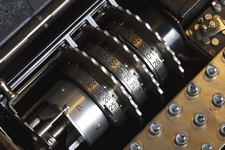 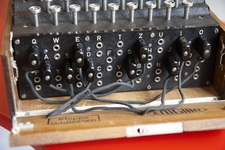 |
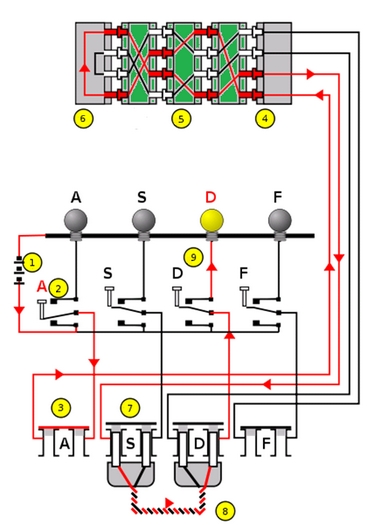 |
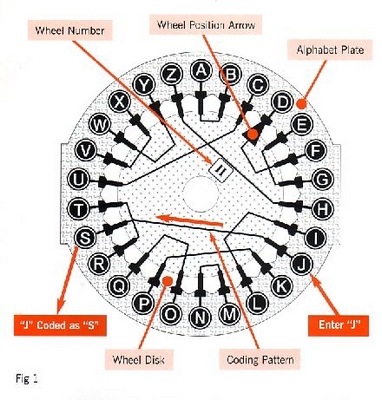
THIS DIAGRAM IS A SIMPLIFIED VERSION OF THE REAL CIRCUIT. Each individual message received by a u-boat was scrambled and had to be put through the enigma circuit. If the letter A was part of the scrambled message, the receiver would press the A key and connect the current from the battery to the plugboard. As there is no plug from A to another letter, the circuit then goes directly to the selected rotars (green). The navy had 8 to select from and the other military groups had 5 to choose from. From here the signal goes to a reflector (6) and back through the rotars. As shown in the diagram, the final output from the rotars is "S" before the signal reaches the plugboard. In the plugboard, the "S" signal is converted to "D" -- and sent back through the rest of the circuit. |
The Germans were never aware that their codes were being broken, and matters to do with Bletchley Park never became public for 30 years after the end of the war. As a result of code-breaking the war was shortened, but it also meant that more and more U-Boat crews never made it back to designated bunker ports in the Atlantic, like the one shown below (Bordeaux, France).
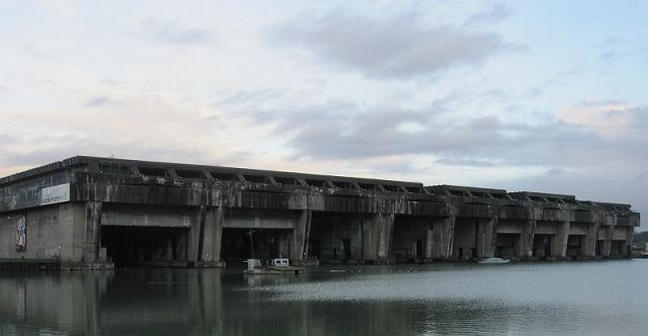
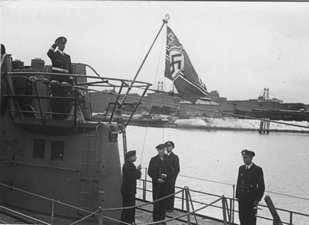
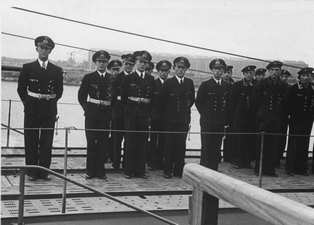
Like the allied crews, photos are all that remain of some crews.
A Game of Cat and Mouse
What happened during WWII is a direct consequence of what happened at the end of WWI and the 20 year period between both wars. It can be argued that much of the causes lay in how matters were handled during reparation. "The conclusion of World War I did not bode well for Germany. The nation went into a state of economic depression. This was caused by the Versailles Treaty as it put limits on Germany's industrial produc- tion, hence severely limiting economic growth. Due to the limited amount of employment, national moral plummeted. This was the spring board for Adolf Hitler's rise in power" (Cryptlogic Duel).German naval messages sent in Morse code were recorded 24 hours a day and deciphered in Hut 8 in Bletchley Park, and then transferred to Hut 4. Messages from the German army and air force were deciphered in other tents -- and passed down the line -- eventually reaching units out in the field. For those responsible for hunting U-boats, any U-boats within vicinity could be spotted at depths up to 30 meters in clear water. When being attacked, U-boats were instructed to dive below 30 meters & proceed silently (around 50 rpm).
Inside U-Boat 96
"German submarine U-96 was a Type VIIC U-boat of the Nazi German Kriegsmarine during World War II.
Her keel was laid down on 16 September 1939, by Germaniawerft of Kiel. She was com- missioned on 14
September 1940, with Kapitänleutnant Heinrich Lehmann-Willenbrock in command"
(Wikipedia).
On 30 March 1945, U-96 was sunk by US bombs while in the submarine pens in Wilhelmshaven, Germany.
In 1941, war correspondent Lothar-Günther Buchheim joined U-96 for a single patrol. His orders were
to photograph and describe the U-boat in action for propaganda purposes. From his experiences, he
wrote a short story, "Die Eichenlaubfahrt" ("The Oak-Leaves Patrol") and a 1973 novel which was to
become an international best-seller: Das Boot.
Das Boot is based on real events. It is the most expensive film made in Germany (estimated to be around $14,000,000). More information about the film can be found here.
Das Boot is based on real events. It is the most expensive film made in Germany (estimated to be around $14,000,000). More information about the film can be found here.