
Pitch Names
The first seven letters of the alphabet are used to represent different pitches (or notes). On a piano, these are repeated one after the other in the same order. Thus, the first 7 white keys on the piano section on the left side are A, B, C, D, E, F and G. The first 15 keys of a piano are shown, of which 9 are white and 6 are black. The white keys correspond to the following pitches: A0, B0, C1, D1, E1, F1, G1, A1 and B1. The number following each pitch is the octave that the pitch belongs to.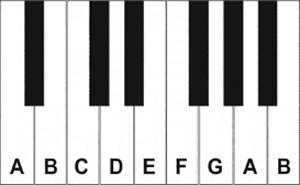
On a piano, keys are organized in repeated sections of white and black keys; one has 5 keys in it and the other has 7 keys. Together, these 12 keys span nearly an octave. C2 to B2 is not an octave apart, but C2 to C3 is. Each time, one reaches a higher C note, the number associated with the pitch increases. E2 to E3 is also octave apart.
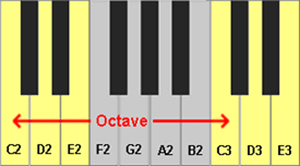
© 2013 -- Reed Music Publications