
Circle of 5ths
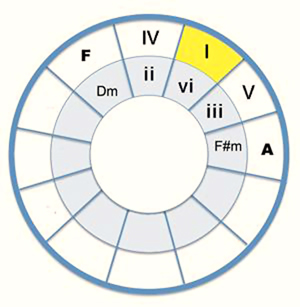
When each of the key signatures are organized so that their tonic notes are a perfect 5th apart rotating clockwise and a perfect fourth rotating counter-clockwise, one can determine which key signatures (and hence what chords associated with that key signature) are -- in relation to each other. And with respect to chords, the diagram shows that C is a IV chord of G, and that G itself is a IV chord of D. As one moves further clockwise, D is a IV chord of A. Every key has its place. The tonality of a song is usually centered around a specific area of the circle. Keys with sharps are on the left and keys with flats are on the right.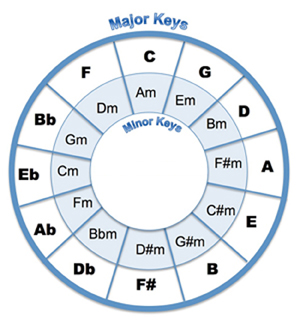
In the key of G, C is a IV chord and D is a V chord. IV, I and V are the most common types of chords used in chord progressions. Often during the bridge of a composition (theme x 2 -> Bridge -> Theme), a song may change keys: for example "I Want To Hold Your Hand" shifts from G to C. During the bridge section, G becomes a V chord. Variation is important in music, and sometimes a change in key is necessary. After the bridge, the song shifts back to G. A rhythmic pattern just prior to the bridge sets us up for the first chord in the bridge: D minor. And then come the lyrics.
© 2013 -- Reed Music Publications