
Chords
Chords are formed from scales. As explained here, triads formed are either major, minor, diminished or augmented. In the early 1800's, German composers started to use Roman numerals to symbolize harmony. Each note in a scale can have a triad or chord built above it. Upper case (Major) and lower case (minor) Roman numerals are used to indicate the type of chord. I, IV, V are major triads/chords, ii, iii, vi are minor triads/chords, and vii is diminished.Major: I ii iii IV V vi vii-o
Minor: i ii-o III+ iv V VI vii-o
Each scale note and associated chord has a Roman numeral assigned to it. As shown in the 2nd diagram, there are also diminished and augmented triads.
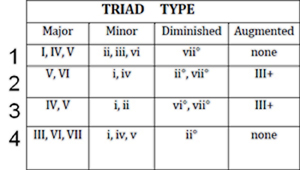
Row 1 is major and row 2 is minor.
Row 3 is the ascending melodic scale
Row 4 is the descending melodic scale.
Chords that are built upon each scale note have a specific triad type, and when extensions are added to a triad, the chord is no longer a triad.
Extensions are 7ths, 9ths, 11ths and 13ths. In music, an extension is a set of musical notes that lie outside the standard range or tessitura. If you are interested in learning about them, consult the main site.
© 2013 -- Reed Music Publications