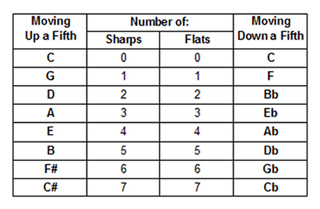
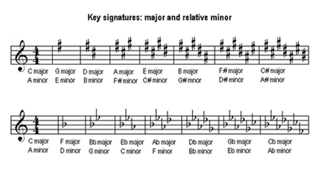
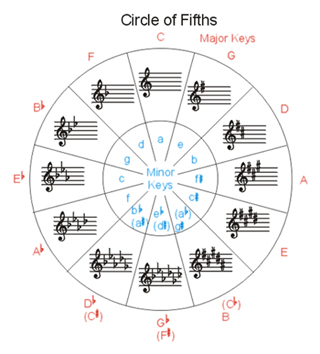
In musical notation, a key signature is a set of sharp or flat symbols placed together on the staff. Key signatures are generally written immediately after the clef at the beginning of a line of musical notation, although they can appear in other parts of a score, notably after a double barline. A key signature designates notes that are to be played higher or lower than the corresponding natural notes and applies through to the end of the piece or up to the next key signature. A sharp symbol on a line or space in the key signature raises the notes on that line or space one semitone above the natural, and a flat lowers such notes one semitone. Further, a symbol in the key signature affects all the notes of one letter: for instance, a sharp on the top line of the treble staff applies to F's not only on that line, but also to F's in the bottom space of the staff, and to any other F's. Instruments tend to stick to a specific range of key signatures on the Circle of 5ths. For instance, band instruments tend to use key signatures with flats, whereas guitar players tend to use key signatures with sharps.