
Diamond Education
For most people, buying a diamond is a new experience, but that doesn't mean it should be overwhelming. Understanding a diamond's quality characteristics is straightforward and simple. Gems Jewelry believes in educating our customers so you know exactly what you are buying. Our diamond education is designed to answer all your questions by explaining a diamond's characteristics, how those characteristics influence appearance, and which are more important than others. In just a few minutes you'll know everything you need to know to find your perfect diamond.
The 4 C-s
We can help you find the right diamond that will provide a lifetime of enjoyment for your loved one. Your appreciation of diamonds will come from your understanding of the 4 C's known as Cut, Clarity, Color and Carat-weight.
Cut
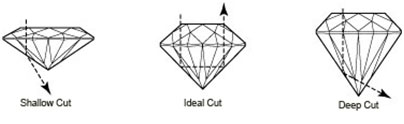
Of the 4 C's, the diamond's cut is the most important factor in determining its brilliance. Put simply, the better a diamond is cut, the more sparkle it will have. There are many shapes that diamonds are cut to but a diamonds cut refers to how well-proportioned the diamond has been transformed into its shape. Ideally, the cut of the diamond is done in a way to best reflect the light that shines into it. This is what produces the sparkle and fire we see in a beautifully cut diamond. If the diamond is cut too heavy, or too shallow, most of the light entering into the crown is released through the bottom of the pavilion resulting in an overall dull appearance. An ideal cut diamond on the other hand, returns most of the light that enters it back through the crown giving it a very satisfying sparkle effect.
Color
A diamond's colour grade actually refers to the lack of colour. In other words, diamonds that are white, containing little or no colour, receive higher quality grades and are more valuable than those with visible colour. Colour in a diamond will act as a filter for the light passing through and degrade the spectrum of light emitted, making it show less sparkle. The grade of color is usually represented by the GIA's professional color scale which gives a letter scale from D for colorless diamonds to Z for diamonds that display a yellowish or brownish color.

Carat
This is the term with which people are most familiar. The carat weight of a diamond is simply the weight of the diamond. A carat is a unit of measurement and 1 carat is equal to 200 milligrams or 0.2 grams. Hence a 1.25 carat diamond will weigh 250 milligrams. The size or carat weight of a diamond cannot be used alone to determine the value of a diamond. A large diamond will not be as valuable if it does not show good color, a fine cut or excellent clarity. All factors (cut, color, clarity and carat weight) are used together to determine the value of a diamond. When choosing the carat size of your diamond, remember to keep a good balance between size and quality. If you are looking for a larger carat diamond, you may have to lower the color or clarity of the diamond as a trade off to the size.

Clarity
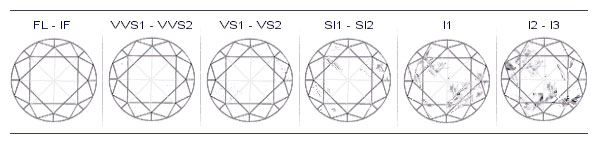
Almost all diamonds have tiny imperfections. Diamonds with few or no imperfections receive the highest clarity grades. The clearer a diamond is, the rarer it is. Most diamonds contain natural 'inclusions' that resemble tiny crystals that make each stone unique. The clarity of a diamond represents the number, type and size of flaws or inclusion which are present in the diamond. Diamond clarity is indicated by a grading system as shown below:
| Grade | Description |
|---|---|
| Fl-IF | Flawless or Internally Flawless. No internal inclusions. |
| VVS1-VVs2 | Very Very Small inclusions. Very difficult to detect under 10x magnification. |
| VS1-VS2 | Very Small Inclusions. Can be seen under 10x magnification and in some cases to the naked eye. |
| SI1-SI2 | Small inclusions. Can be seen under 10x magnification and may be visible to the naked eye. |
| I1-I2-I3 | Imperfect. Inclusions are visible under 10x magnification and in most cases to the naked eye. |
Diamonds with a clarity grade of Flawless or Internally Flawless and are very rare and almost always expensive. The fewer inclusions found in a diamond, the more valuable and expensive it becomes. When choosing a diamond, you should select a clarity grade in which the inclusions are not visible without magnification.
Shape
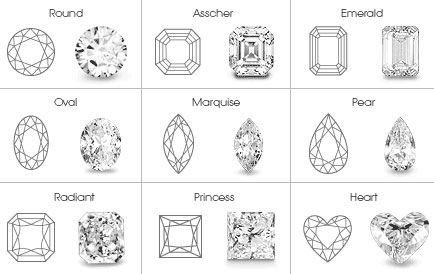
As the name suggests, shape (round, princess, radiant, etc.) describes a diamond's form, primarily as viewed from above. All diamond shapes have different attributes, but overall the beauty of the individual shapes is a matter of personal taste. Shape does not affect the quality of the stone. If it is well cut its brilliance and value will endure no matter what. The shape of the rough diamond crystal usually dictates the shape of the stone. All are cut for maximum fire and brilliance, but facet shape varies with the cut and as a result, filters light differently. Additionally, some designs are more suited to a particular shape.
Certification
To ensure the value of a diamond has been properly determined, independent laboratories will inspect and write a report on each individual diamond. These reports include a physical inspection of the diamond and a written report called a grading report or diamond dossier, which will accompany the diamond. A gemologist will place the diamond under a microscope and carefully determined its proportions, color, symmetry, fluorescence, cut, clarity and carat weight.
These laboratories exist to protect consumers and the diamond industry by creating standards used to grade loose diamonds The most common independent certification laboratories groups include:
- GIA - Gemological Institute of America
- AGS - American Gem Society Laboratories
- EGL - European Gemological Laboratories
- IGI - International Gemological Institute
At Gems Jewelry, we prefer diamonds certified through GIA, AGS or EGL (USA). These laboratories have an excellent reputation in the North American market for providing accurate and consistent unbiased reports. All diamonds purchased from Gems Jewelry will be accompanied with their grading certificate.
Shopping Cart


Ruby Necklace
$179.99

Emerald Ring
$149.99

Store Directory
Getting Married?
Marriage, ultimately, is the practice of becoming passionate friends -- and we at Gems Jewelry know exactly what you can give your loved one in order to give her that special smile. Marriage is like a school. It is a life-long education that is full of surprises and joys single people often dream about -- and we invite you to become better acquainted with all that we have to offer. In the end, you will thank us and she will thank you.
Go ahead, buy her that diamond ring. Yes, it may cost a lot, but the return on investment is priceless and could save your marriage. Accept the things to which fate binds you, and love the people with whom fate brings you together -- but do so with all your heart. At Gems Jewelry, we tell all our customers that the more you invest in a marriage, the more valuable it becomes. And if you're not getting married, buy some- thing for yourself -- as jewelry is not just for married folk.
Susan, a recent employee of ours knows all about jewelry and would be pleased to help you find that right piece of jewelry for your loved one. Married herself, she knows what women like and even what men like. Or why don't you ask Robert, our single bachelor. He has good knowledge of gems, jewelry & all that sparkles. We would all be pleased to assist you in any way. If you have any suggestions, let us know. We'd love to hear from you.
Make Your Own Jewelry
We have all you need to make your own jewelry. Check out our Beads & Jewelry Making Supplies. We stock more than 3,500 beads, jewelry kits & findings. We hope that our kits will help to inspire you to create great new jewelry pieces, whether you make them for yourself or sell at craft fairs and jewelry parties. Get busy with your pliers!
If you want to learn how to make jewelry, you need to try one of our jewelry making starter kits. They include everything you need to begin the craft of jewelry making. We teach you how to make beaded bracelets, necklaces and earrings, all from a gorgeous selection of beads and our comprehensive range of jewelry findings. Take a look at our jewelry starter kit section in our stores for the full details.
All of us at Gem Jewelry love to look at new jewelry, and invite you to bring yours in. We buy gems and jewelry at wholesale prices and sell them to our many customers in our retail outlets. If you're really good, we might even hire you. That's right. You too can work for Gems Jewelry. Why not stop by today and fill out an application form. We are always looking for good talent.
We Are Hiring
Due to expansion, we are hiring new employees who wish to become part of our team. We'd love to hear from you and hear what you can offer our company. Many of our employees are former hobbyists and some have dedicated their lives to finding rare gems and jewelry abroad. Our newest hire, Dale Smith, has just come back from a trip overseas and is a valued member of our team. You too, could work for Gems Jewelry.


