Convoys
During the war, it was necessary to supply Britain with food, weapons and fuel to carry on the war effort. In an attempt to stop these convoys, U-boats went as far as the St. Lawrence River in Canada, and as far away as New York. Patrols sunk a lot of tonnage in the Atlantic -- and even went into the Mediterranean Sea. "From Sept 1941 to May of 1944, Germany managed to send 62 U-boats into the Mediterranean. All these boats had to navigate the dreaded British-controlled Straits of Gibraltar where 9 U-boats were sunk while attempting passage -- and 10 more had to break of their run due to damages. No U-boats ever made it back into the Atlantic and all were either sunk in battle or scuttled by their own crews" (Wikipedia).Karl Doenitz didn't like sending his U-boats into the Mediterranean for good reason: few returned to the Atlantic, the main area of operation. The straight of Gibraltar was not only narrow (14km), but dangerous as well. The Mediterranean U-boat Campaign lasted approximately from 21 September 1941 to May 1944. The German Navy (Kriegsmarine) tried to isolate Gibraltar, Malta and Suez -- and disrupt Britain's trade routes. More than sixty U-boats were sent to disrupt Allied shipping.
Code Breaking
At the beginning of June 1943, U-boat forces were cut off vital information regarding Allied operations in the Atlantic. In that month, the British Admiralty changed naval codes, and the German code breaking service, B-Dienst, which had been reading much of Allied traffic since February 1942, could no longer provide decrypts of Allied messages. This incalculable setback meant that U-Boats were deprived of valuable tactical informa- tion. Up to the end of the war, the Germans were not able to break the new Allied naval code. In 1944-45, there is a marked turn around in results (a lack of intelligence can be perilous):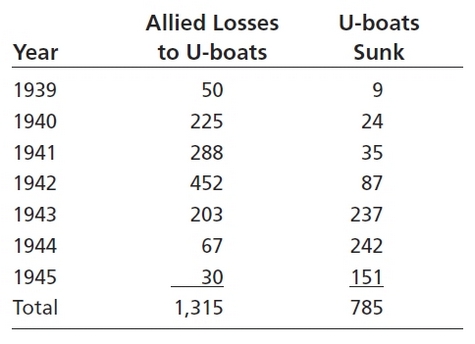 |
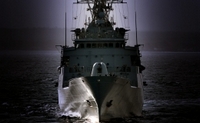 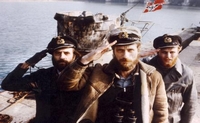 Das Boot (based on U-96) |
Das Boot
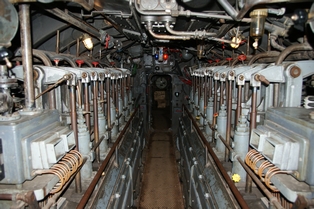
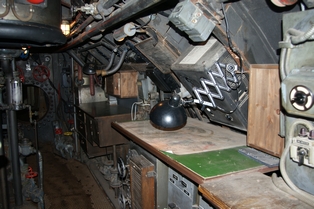
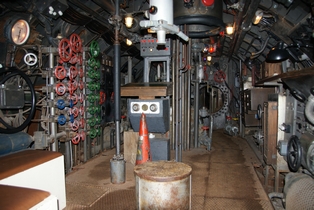
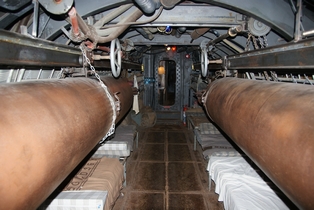
In 1981, Wolfgang Petersen released a film based on the novel of the same name, starring Jürgen Prochnow, Herbert Grönemeyer, and Klaus Wennemann. It has been exhibited both as a theatrical release and as a TV miniseries. Lothar-Günter Buchheim expressed great disappointment with Petersen's adaptation in a film review, stating that its depiction was overdone and cliched for theatrical effect. Based on real events associated with U-96, Buchheim is the real Leutnant Werner (Ensign): The naive, but honest narrator. In the film, Werner is mocked for his lack of U-boat experience. The real U-96 is 67 metres long: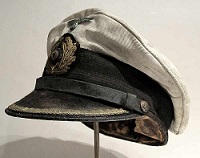 Name: U-96
Ordered: 30 May 1938
Builder: Germaniawerft, Kiel
Laid down: 16 September 1939
Launched: 1 August 1940
Commissioned: 14 September 1940
Type VIIC submarine
Length: 67.1 m (220 ft 2 in)
Beam: 6.2 m (20 ft 4 in)
Propulsion: 2 × diesel engines. Max rpm: 470-490
2 × electric motors. Max rpm: 296
Speed: 17.7 knots (20.4 mph; 32.8 km/h) surfaced
7.6 knots (8.7 mph; 14.1 km/h) submerged
Range: 15,170 km (8,190 nmi) at 10 kn (19 km/h) surfaced
150 km (81 nmi) at 4 kn (7.4 km/h) submerged
Test depth: 230 m (750 ft)
Crush depth: 250-295 m (820-968 ft)
Complement: 44-52
Armament: 5 × 533 mm (21 in) torpedo tubes (four bow, one stern)
14 × torpedoes or 26 TMA mines
1 × C35 88mm gun/L45 deck gun (220 rounds)
Axis and Allied Losses
In any armed conflict, losses are inevitable. Having survived the war, one of the real captains of the U-96 visited Bavaria Studios where Das Boot was filmed. His name is Heinrich Lehmann-Willenbrock. Many of the men he sailed with are memorialized in Heikendorf, Germany (U-Boot-Ehrenmal Möltenort).The number of fallen German submariners is as follows:
1914-1918 -> 5,249 Fallen / 199 U-Boats
1939-1945 -> 30,003 Fallen / 739 U-Boats
The number of Allied men who fell is lower.
One estimate puts the figure at around 23,000 (Battle of the Atlantic).