Art of the 17th Century

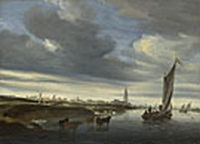
The National Gallery in London houses one of the greatest collections of Western European painting in the world. "These pictures belong to the public and entrance to see them is free." It's collection contains over 2,300 works, including many famous works, such as van Eyck's Arnofini Portrait. This web- site focuses on the Dutch masters of the new "United Prov- inces" region in the Netherlands. As shown on their map, this is the orange area of Rooms 16-17, 21-29 and 31 (Level 2).


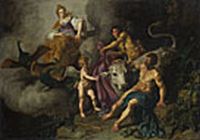
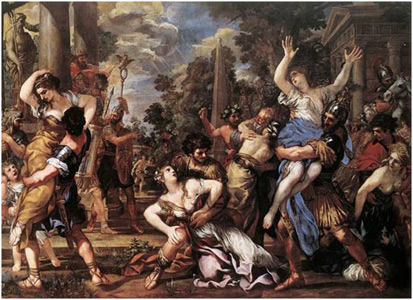
Baroque is a term used to describe a period and style of art. Baroque art became popular in the 1600s. It started in Italy and quickly moved to other areas of Europe. The Baroque style began in negative response to Mannerism, at the request of the Catholic Church. The church wanted its religious paintings to become more emotional and dramatic. In Baroque art there was generally action and movement. Angels flew, people fought, crowds cowered in fear and saints rose to the heavens. When one views art, one shouldn't just view works by those who are most famous. Even lesser-known painters adopted the Baroque style. After Baroque period, came the Roccoco period (or late Baroque).

Portraiture was also common amongst wealthy patrons and noblemen. During the 1600s, Rembrandt specialized in this area -- and as political changes occurred, so did the art. In the Netherlands, Dutch masters copied their predecessors, and in turn, developed their own style. Artists such as Rembrandt and Vermeer became famous -- and their works have spread throughout North America and Europe. Works created in the Netherlands are in galleries and museums worldwide, as they have been bought/sold to the highest bidder (and stolen during World War II).

The collection in the National Gallery is open to the public and is in designated display rooms. In the the Netherlands, even lesser-known artists were influenced by trends in the 17th century. Like Vermeer, Pieter de Hooch is also a Delft painter. His works can be viewed in Room 25. With respect to Dutch art, it is suggested that one proceed from room to room, starting with Room 16. One, of course, can begin elsewhere and pass through Dutch Baroque art -- as art from other areas of Europe also flourished -- in the 17th century.

During this period, the Protestant Reformation was taking place in Europe. In many ways, art cannot be separated from history -- as the two are closely linked. Art is reflective of history and this can be seen in works by painters in Italy, Spain, France and the Netherlands. This is a time when the growth of Science is strongly taking shape. In the Habsburg Netherlands, by 1648, a new state had emerged: the Seven United Netherlands. In the National Gallery, there are many paintings from this period. As shown in any Baroque timeline, Rembrandt lived from 1606-69. His work is in Room 16, Room 23 and Room 24. Famous paintings can be expensive for a gallery or museum.
  • Room 16

    Rembrandt & Dutch Landscapes

    Rembrandt is perhaps the most famous and versatile painter of the 17th century in the Netherlands. He moved to Amsterdam in about 1631, where he quickly established himself. Born in 1606 in Leiden, he grew up in the "United Provinces" (Netherlands). In 1579, they claimed their independence from Spain, but it took 30 years of armed conflict to drive the Spanish from their soil.

    Continue Reading

  • Room 17

    Dutch Italianate Painting

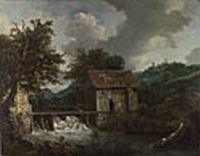
    In the 17th century, a trip to Italy was considered an important part of an artist's training. Dutch painters went there to study landscapes, ancient ruins and sculptures. On their return to the Netherlands, many of these artists continued to paint Italianate landscapes; others adapted the lessons they had learned to suit Dutch taste for religious and secular paintings.

    Continue Reading

  • Room 23

    Rembrandt and Dutch Painting

    The works here mark a period of intense political change. This was a turbulent time: the Dutch provinces were struggling for independence from Spain, which finally came in 1648, when a treaty was signed. This Prote- stant region, with its Reformation affinities and Northern realist heritage, now evolved its own tradition. In painting, there was renewed emphasis on realism and simple, everyday things.

    Continue Reading

  • Room 25

    Vermeer and Delft Painters

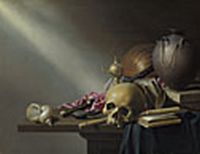
    Domestic scenes featuring richly dressed women, their maids and suitors are characteristic of painting from Delft during the 17th century. Johannes Vermeer and Pieter de Hooch excelled in work of this type. They paid great attention to perspective, use of space and light in carefully composed interiors and court- yards. Many works focused on Still Life, in particular Harmen Steenwyck's "An Allegory of the Vanities of Human Life" (1640).

    Continue Reading


Art in the Baroque Period

The Baroque period in paining corresponds roughly to the 17th century. In Italy and Spain, the Catholic Church, in its Counter-Reformation mood, put pressure on artists to seek the most convincing realism possible. In the North too, Rembrandt and Vermeer, each in their own separate ways, pushed forward the limits of realism.


The National Gallery
Trafalgar Square
London, WC2N 5DN

Tel: +44 (0)20 7747 2885
Fax: +44 (0)20 7747 2423

This website was designed by ARC Web Design
Copyright © 2013 - All Rights Reserved