Welcome to MusicTheory ABRSM
Take a lesson based on the Royal Schools of Music's syllabus and prepare for your next theory exam. If you're a teacher, you'll be able to manage your student list and track their progress through each grade. If you're a student, you can take lessons, study example compositions and talk about music theory with other members -- all in preparation for the exams in each grade. Learn to transpose from one key to another, play major and minor scales or create one or more compositions based on the theory you have learnt so far. This site has all you need: lessons, compositions, worksheets and exams. After logging in and studying assigned theory, you'll be better prepared to sight read written music with simple and compound meters, transpose music and write theory exams. Whether you're a teacher or student, register and login today. We have content for all levels of ability. Together, you can analyze a composition and discuss the usage of music theory. Learn more about music theory and compositions today! Just register and create a profile.
Here is an example of a MusicTheory lesson:
On a piano, keys are organized in repeated sections of white and black keys; one has 5 keys in it and the other has 7 keys. Together, these 12 keys span nearly an octave. C2 to B2 is not an octave apart, but C2 to C3 is. Each time, one reaches a higher C note, the number associated with the pitch increases. G2 to G3 is also octave apart.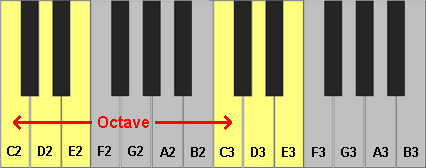
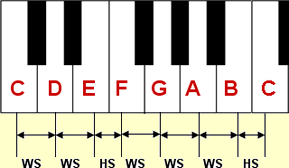
An octave is 6 whole tones (WT) or 12 half-tones (HT). On a piano, a half-tone (or semitone) is the smallest distance between two notes. The distance between E & F, as well as B & C is a semi-tone. As shown below, two semi-tones is the same distance as 1 whole tone. Count the number of keys that are above or below the note you start from. The concepts of a half-step and whole-step come from ancient Greece and were apopted in Western music, as discussed at Wikipedia. An octave can be divided into 2 tetrachords.